
Lightweighting in PET Bottles: How Manufacturers Cut Plastic Without Cutting Quality
Lightweighting reduces the PET in every bottle to save cost and cut waste. Learn how it works, where the limits are, and how quality is protected.
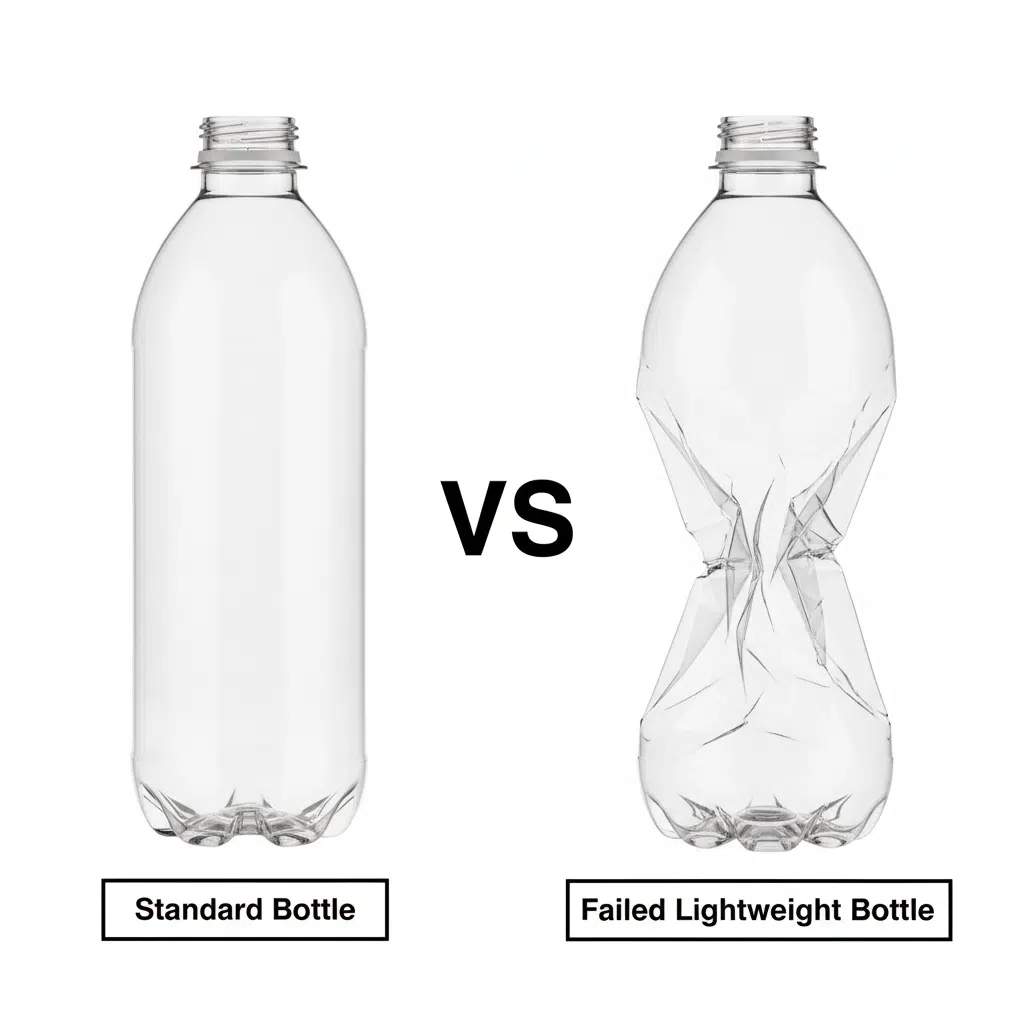
Pick up a plastic water bottle from a decade ago and one from today, and the newer one likely feels noticeably lighter. That is lightweighting — the deliberate reduction of how much PET goes into each bottle and preform. It is one of the quiet success stories of packaging: less plastic, lower cost, and the same job done. Here is how it works, and why it is not as simple as just using less material.
What is lightweighting?
Lightweighting means engineering a bottle to use the minimum amount of PET needed to do its job reliably. Because a bottle starts as a preform, lightweighting usually starts by reducing preform grammage — the weight of the preform in grams — along with redesigning the neck and bottle to need less material.
A lighter preform means less resin per unit. Multiply that across millions of bottles and the savings — in cost, plastic and carbon — are enormous.
Why it matters
- Less plastic produced and discarded. The most sustainable gram of plastic is the one never used. Lightweighting cuts material at the source.
- Lower material cost. Resin is the biggest cost in a preform, so trimming grams directly trims cost per bottle.
- Lower transport emissions. Lighter packaging means lighter loads.
- It complements recycled content. Pair lightweighting with rPET and you reduce both how much material you use and how much of it is virgin.
Where the plastic gets removed
Lightweighting typically targets a few areas:
- The neck finish. The shift from the long PCO 1810 neck to the shorter PCO 1881 neck was itself a lightweighting move — a shorter neck uses less resin. See neck finishes explained.
- Preform grammage. Refining the weight so the bottle has exactly the material it needs — no more. Our preform range offers closely spaced weights for exactly this fine-tuning (for example, several Alaska options between 17 g and 21 g for 1-litre bottles).
- Bottle design. Ribs, flutes, and base geometry that add strength through shape rather than material, so a thinner wall still performs.
The limits: where you cannot cut
Lightweighting has a floor. Remove too much and the bottle stops doing its job:
- Structural integrity. The bottle must survive filling, capping, stacking and handling without collapsing or denting.
- Top-load strength. Bottles are stacked; they must bear the weight above them.
- Pressure resistance. Carbonated products push outward — the bottle must hold pressure without deforming.
- Drop performance. A full bottle must survive being dropped without splitting.
- Consumer perception. A bottle so flimsy it crushes in the hand can feel cheap, even if it technically works.
The art of lightweighting is finding the point just above these limits — the lightest bottle that still passes every test.
How quality is protected
Cutting grams safely is an engineering exercise, not guesswork:
- Match grammage to the exact bottle and fill. The right weight depends on volume, product, pressure and design — which is why weight selection matters so much. See our preform weight and size chart.
- Design strength into the shape. Good bottle geometry lets thinner walls perform like thicker ones.
- Test rigorously. Top-load, drop, pressure and burst testing confirm a lightweighted design holds up before it goes to production.
- Control preform consistency. Tight, batch-to-batch grammage control means a lightweight design behaves the same every time — variability is the enemy of cutting close to the limit.
Lightweighting is a partnership
Getting it right needs the bottler and the preform maker to work together: the preform maker supplies consistent, correctly specified preforms, and the bottler validates them against real filling and handling conditions. Pushing grammage down without testing is how you end up with collapsing bottles and line stoppages.
The bottom line
Lightweighting cuts the PET in every bottle to save cost and reduce waste — a real sustainability win — but only works when the reduction is engineered and tested, not simply guessed. The goal is the lightest bottle that still performs flawlessly.
Looking to optimise the weight of your preforms without sacrificing quality? Our team can help you find the right grammage. Explore our preform range or get in touch.