
The PET Preform Manufacturing Process, Step by Step (Injection Molding Explained)
How PET preforms are made — from drying resin to injection moulding, cooling and quality control. A clear, step-by-step look inside preform production.
A PET preform looks simple — a small moulded tube of plastic. But producing one that blows cleanly into a flawless bottle, batch after batch, takes a tightly controlled process. This article walks through how PET preforms are manufactured, step by step, using injection moulding.
Understanding the process helps buyers know what they are paying for, and why consistency and resin quality matter so much.
The raw material: PET resin
Everything starts with PET resin — small pellets (also called chips) of polyethylene terephthalate. For food and beverage packaging, this must be food-grade virgin resin. Resin also comes in different grades defined by intrinsic viscosity (IV), which roughly indicates molecular weight and determines suitability for water, carbonated drinks, hot-fill and so on.
Choosing the right resin grade for the application is the first quality decision, long before any machine runs.
Step 1: Drying the resin
PET is hygroscopic — it absorbs moisture from the air. If wet resin is melted, the water causes the polymer chains to break down (hydrolysis), producing weak, hazy, brittle preforms. So the first step is drying the pellets in a desiccant dryer, typically for several hours at high temperature, until moisture is driven down to very low levels.
Skipping or shortcutting drying is one of the most common causes of poor preforms.
Step 2: Melting and plasticising
The dried pellets are fed into the injection moulding machine. Inside a heated barrel, a rotating screw conveys the pellets forward while heat and friction melt them into a uniform, molten PET at around 270–290°C. The screw doubles as a pump, building up a measured shot of melt ready to inject.
Step 3: Injection into the mould
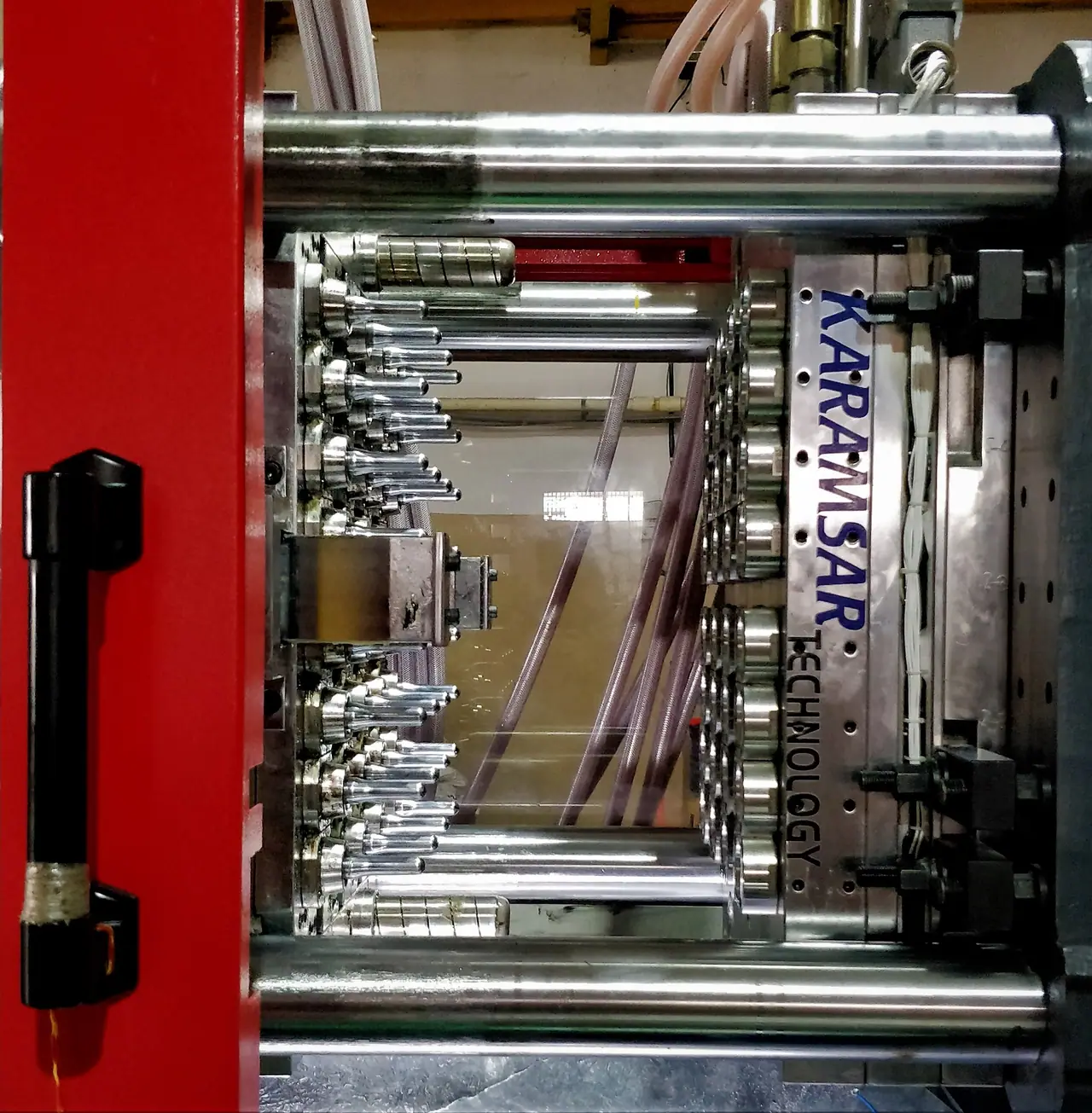
This is the heart of the process. The molten PET is injected under high pressure into a multi-cavity mould. Each cavity is precisely machined to the shape of one preform, including the exact threads of the neck finish.
- Multi-cavity tooling means one machine cycle produces many preforms at once — commonly 16, 32, 48, 72 or more cavities — which is what makes preforms economical at scale.
- The neck finish is formed by neck rings that must be dimensionally perfect, because the neck never changes shape afterwards.
Step 4: Holding and cooling
Once filled, the melt is held under pressure while it cools and solidifies against the cold mould walls. Cooling must be fast and even. PET has a special requirement here: it must be cooled quickly through a certain temperature range so it stays amorphous (clear) rather than turning crystalline (cloudy/white). A hazy or pearly preform usually signals a cooling or drying problem and will not blow into a clear bottle.
Step 5: Ejection and post-cooling
The mould opens and the preforms are ejected — often into a cooling robot or post-mould cooling system that continues to cool them uniformly, inside and out, after they leave the mould. This prevents deformation and internal stress while the still-warm preforms finish setting.
Step 6: Quality control
Before preforms are packed, a good manufacturer checks them against spec. Typical checks include:
- Weight — every batch is weighed; grammage must stay within tight tolerance.
- Neck dimensions — thread and bore checked with gauges so caps fit reliably.
- Height and body dimensions — measured against the drawing.
- Clarity and appearance — inspected for haze, bubbles, black specks, crystallinity or a cloudy neck.
- IV retention — ensuring the resin has not degraded during processing.
At ASTR PET, weight, height, neck and IV checks are run on every batch before it leaves the floor — because a defect caught here saves a bottler from scrap and downtime later. See common preform defects for what these checks catch.
Step 7: Packing and dispatch
Approved preforms are packed — usually in large bags or bulk boxes — labelled with their specification, and dispatched to the bottler, who will later blow them into bottles using stretch blow moulding.
Why the process explains the price
When you compare preform quotes, the process above is what you are really comparing:
- Resin choice — food-grade virgin resin costs more than blended or reground material, but it is the difference between consistent, safe bottles and unpredictable ones.
- Drying and cooling discipline — proper drying and cooling take time and energy, and they are exactly what prevents haze, weak walls and blowing failures.
- Tooling and QC — precise multi-cavity moulds and batch-level checks cost money but deliver the consistency that keeps your bottling line running.
A suspiciously cheap preform usually means a compromise somewhere in this chain.
The bottom line
PET preform manufacturing is a precision injection-moulding process where resin quality, moisture control and cooling discipline decide the outcome. Done well, it produces preforms that blow into clear, strong, consistent bottles every time.
Want preforms made to a spec you can rely on? Explore our PET preform range or talk to our team in Indore.